Monday, February 15, 2010

In Honor of Presidents Day

As a fitting coda to my article of yesterday, I offer the following:

"Books serve to show a man that those original thoughts of his aren't very new at all." 
Abraham Lincoln

Saturday, February 13, 2010

Don't Be Original!

In my previous article, I described the angst experienced by participants in the What’s In a Name activity as they tried to come up with “original” names for items when faced with no restrictions on their choices.

The ego-driven desire for originality also afflicts many people in business meetings, who seem to care more about impressing others with their brilliance rather than collaborating with their team members to work toward a joint result. This “look-at-me” focus can also lead to silo-based behavior, with each person primarily concerning himself with his own perspectives and those of the group with which he identifies.

Clearly, the urge to impress others with our wonderfully original thoughts is one of those negative “things between” that get in the way of attaining a state of mastery. And, as Keith Johnstone makes clear in his book Impro for Storytellers, even performance improvisers can run afoul of this urge. As Johnstone observes:

"When [improvisers] are trying to think of clever things to say, they’ll pay scant attention to anyone else."

The compulsion to be original tends to keep people (whether performance improvisers or Daily Improvisers) turned inward toward their own thoughts rather than outward toward their environment. Instead of listening to and integrating the ideas and viewpoints of others, the self-referential improviser might plow ahead into an area that only the little playwright in her head finds interesting.

So what’s the remedy for the urge to always be original? Simply this, in the words of Patricia Ryan Madson: Be average! For more on this, refer to my earlier article on Robert Benchley: The “Average” Man.

Granted, there are times when truly original thinking is required – but, even then, such thinking doesn’t have to come from a single inspired individual but can emerge from a team’s collaborative effort. And even when true originality is called for – whether from an individual or from a team – the answer isn’t necessarily to wipe the mental slate clean and devise a wholly new play. As I’ll show next time, the placement of useful boundaries on our thinking can (paradoxically) help us think outside the box.

Saturday, February 6, 2010

Putting Useful Boundaries on Our Thinking

In my organization-development practice, I often conduct an improv-based activity I call What’s In a Name?

In Round One, I have participants walk around the room, point to objects, and call out each object’s name as they point (“table,” “white board,” “light switch,” etc.). Most participants, of course, can do this with no problem.

In Round Two, participants are again told to walk around and point to objects, but this time they must call out a name other than the actual name of the object to which they’re pointing.

Invariably in Round Two, you can almost hear the mental gears grinding as participants strain to think of a name from the whole universe of possibilities available to them. During the debrief, many participants attribute their hesitation to the pressure they feel to think of something “creative” or “clever.”

However, occasionally in Round Two, a participant will rattle off object names just as easily as he did in Round One. When asked to share his strategy, the participant will often let the others in on the “secret”: Think of another category – like “barnyard animals” – and assign names from that category (“chicken,” “horse,” “pig,” etc.) to each of the pointed-to objects.

I use this activity to illustrate the value of placing useful boundaries around our thinking, in order to avoid becoming – like most of the Round Two participants described above - paralyzed by the tyranny of unlimited choice whenever we’re contemplating a course of action. Useful boundaries help us frame our thinking so that we can focus our mental energies on the most promising possibilities and options, eliminating red herrings and irrelevant considerations right upfront.

For the Daily Improviser, useful boundaries can take many forms:
  • Her own experience, and the experience of others (aka “advice” and “mentoring”);
  • Checklists to help her prioritize actions and avoid having things fall through the cracks;
  • Templates to help her compose documents (and thereby avoid the dreaded “blank page”);
  • Structured processes for carrying out certain procedures, most notably the processes associated with Project Management practice.
But wait! If “Daily Improvising” is all about applying the skills and attitudes of performance improvisers to everyday life, why am I suggesting that the Daily Improviser put boundaries on her thinking? Don’t performance improvisers keep themselves open to the universe of possibilities and make up everything anew on the spot?

Well, if you’re a regular reader of this blog, then you’re probably way ahead of me. As I mentioned in an earlier article, performance improvisers themselves commonly place useful boundaries on their thinking to facilitate their actions. By using catchphrases, clichés, accents, and pre-set scene structures, they are able to put a loose framework around their scenes and provide focus for their in-the-moment choices.

I’ll continue next time with some further examples of useful boundaries as described by the improv guru Keith Johnstone in his book Impro for Storytellers.

Saturday, January 30, 2010

Are You Experienced?

In recent Daily Improviser articles, I’ve been exploring the concept of mastery, defined by Steve Zaffron and Dave Logan (in their book The Three Laws of Performance) as “nothing between you and the thing you’re dealing with.” Zaffron and Logan say that mastery is the key to attaining our highest levels of performance.

The achievement of mastery would seem to require cutting through our biases, assumptions, conditioned responses, and received cultural wisdom in order to directly experience the reality before us. As I’ve noted, though, I’ve been wrestling with the question: Is such a state possible?

Not at all, says Steven Pinker. In his book The Blank Slate, Pinker describes the efforts of the 20th Century modernist and postmodernist movements to achieve the goal of exposing people to “fresh, raw experience.” Through their use of dissonant, incongruous, and unsettling forms and their derisive attitude toward “beauty,” modernism and postmodernism were intended to “strip away the false sense of routine experience and interpretive framing, and to make us experience nakedly and anew the immediacy of reality through our peeled and rejuvenated senses.”

However, by citing recent research in evolutionary psychology, Pinker casts doubt on our ability to tap into direct experience.

“Modernism and postmodernism cling to a theory of perception that was rejected long ago: that the sense organs present the brain with a tableau of raw colors and sounds and that everything else in perceptual experience is a learned social construction…. We can no more turn [our innate organizational systems] off and get immediate access to our sensory experience than we can override our stomachs and tell them when to release their digestive enzymes.”

In addition, Pinker notes, our innate organizational sense does not stop at helping us apprehend the physical structure of the world.

“It also colors our visual experience with universal emotions and aesthetic pleasures. Young children prefer calendar landscapes to pictures of deserts and forests…. Babies prefer consonant musical intervals over dissonant ones, and two-year-olds embark on a lifetime of composing and appreciating narrative fiction when they engage in pretend play.”
Pinker would seem to question whether we really can attain the “nothing between” state of mastery when we interact with others:
“When we perceive the products of other people’s behavior, we evaluate them through our intuitive psychology, our theory of mind. We do not take a stretch of language … at face value, but try to guess why the producers came out with [it] and what effect they hope to have on us.”
In my previous article, I noted how performance improvisers – people who supposedly do tap into direct, in-the-moment experience – themselves use forms such as catchphrases and archetypal scenes to “come between” them and their performances. Pinker’s observations about the findings of evolutionary psychology would appear to provide even further doubts about our ability to strip away everything between us and reality in our pursuit of mastery.
 
But I wonder if Pinker doesn’t go a bit too far in criticizing the creators of “upsetting” art for attempting to shake people out of their complacency. For example, I believe that atonal works such as John Coltrane’s Ascension do challenge the listener to reexamine his entire concept of music – and to question long-held assumptions about the nature of art and creativity in general. Certainly in my own case, such musical encounters helped me to hear with new ears and revealed virgin territory for my curiosity to explore – exactly the type of “stripping away” of assumptions that I believe the mastery concept contemplates.

Saturday, January 23, 2010

Improv: Cutting Through the Fog?


I left off last time by citing Keith Sawyer’s contention that improvisation provides a better model for describing everyday interactions than does Erving Goffman’s script model. On the face of it, improv would seem to be the Daily Improviser’s ideal entrée to the “nothing between” state of mastery which I’ve described at length in this blog.

After all, isn’t that what improv is? Creating something out of whole cloth - something that had never previously existed - based on being fully in the now and tapping a mainline to direct experiencing of the current reality?

Actually, Sawyer’s observations cast a different light on the role that improv plays in our communications. In the process, I think, he further brings into question the feasibility – and even the necessity - of attaining mastery as Zaffron and Logan define it.

Sawyer notes that we don’t literally perform word-for-word scripts in our daily interactions, as Goffman’s theories would seem to imply. Yet, he says, neither do we completely make up our communications anew every time. Based on his observations of a wide variety of situations, Sawyer says:

“Although our conversations are not fully scripted, there are two kinds of structures that we use in conversation. First of all, we often weave in catchphrases – little pieces of script that are building blocks in our improvisations. Second, some of our conversations are created within an overall framework – a common situation like the restaurant or the post office – where the flow of the conversation is predetermined.”

To illustrate his point, Sawyer describes his observations of some natural improvisers, i.e., children at play. Sawyer notes one instance in which some children began performing a Christmas scene that began with one child calling out the catchphrase, “Santa Claus is coming!” Rather than immediately enacting a standard “Christmas script,” though, the other children spontaneously overlaid a “horror movie” script on the proceedings by screaming and running to their (pretend) beds. The scene then continued with a procession of other holiday icons (the Easter Bunny, Halloween figures) who provoked mock terror rather than glee with their arrival.

So, even in improv, there is “stuff” between us and our environment – and much of it seems like good stuff, which we bring in from our past to convey meaning and to help make sense of the world in front of us right now. Rather than playing make-it-all-up as she encounters her world, the Daily improviser may well legitimately use “shorthand” phrases and words and concepts that help her communicate with others. And as with the children in Sawyer’s example who amalgamated multiple “scripts,” she can also combine elements from her experience – knowledge, conclusions, observations, theories – in new ways to deal with new situations.

In upcoming articles, I’ll continue to explore the topic of “direct experiencing of reality” and the stuff that can – and perhaps should – intervene between us and the things we’re dealing with. I’ll also explore what I perceive to be the limits of our reliance on existing structures such as catchphrases and loosely scripted frameworks.

Saturday, January 16, 2010

The Daily Improviser Meets the Daily Script


"You can observe a lot by watching!" - Yogi Berra

Last time, I revealed my concerns about whether we can really attain a state of mastery, in the sense of being able to purge everything between us and the thing we’re dealing with. Can we attain this state – and must we in order to perform at our best?

An article I recently encountered – “The Improvisational Performance of Everyday Life,” by Dr. R. Keith Sawyer – may shed some light on these questions. Sawyer cites the work of the sociologist Erving Goffman, the author of the seminal book The Presentation of Self in Everyday Life. In that book, Goffman contended that our daily interactions (or “performances”), far from being spontaneous and unstructured, are in fact highly constrained by the “scripts” we learn from our culture. Examples include the “Telephone Script” (the words we use to conduct a telephone conversation) and the “Restaurant Script” (the words we use to interact with a server).

Clearly, Goffman would say, we are not blank slates upon which meaning is newly composed with each interaction.

In addition, Sawyer cites other authorities who note that most of our daily interactions are highly indexical, that is, our communications indicate something that isn’t contained in the literal meaning of the words we use. Our conversation is loaded with catchphrases, clichés, inflections, and accents that convey something about our attitudes and expectations (shades of the subtexts I described in an earlier article). In a comment that calls to mind the above-cited Yogiism, Sawyer says:

“Some linguists estimate that as much as 90% of all of our spoken language is at least partially indexical – in other words, very little of what we say is context-free.”

So, according to Goffman and the other researchers, not only do we continually apply pre-set scripts in our interactions, but we convey meaning in other ways that prevent others from interpreting those scripts literally.

So much for mastery, then. All of these recycled scripts with subtextual meanings would seem to constitute heaps of stuff that interfere with our attaining that elusive “nothing between” state.

But Sawyer then proposes that a new paradigm, based on improv theory and practice, be overlaid on Goffman’s script theory. Does that mean that the Daily Improviser should literally become a performance improviser in everyday life, making up everything new on the spot based on exactly what’s in front of him at the moment?

[This is the point in the Blog Script where the author says: Stay tuned!]

Saturday, January 9, 2010

The Improvisational Life and the Blank Slate


Awhile back, I dealt at length with Steve Zaffron and Dave Logan’s book The Three Laws of Performance. In describing the Second Law – “How a situation occurs arises in language” – I cited Zaffron and Logan’s observation that “whenever you say something, other communication is carried along with it.” This phenomenon, which they call “the unsaid but communicated,” can easily be ignored by individuals and organizations, who often are content to deal with only the surface level of issues. As a result, the real issues fester unacknowledged until they can no longer be overlooked – or effectively handled.

These “unsaid but communicated” messages are just one example of the barriers that prevent us from achieving mastery in our performance, a level which Zaffron and Logan define as “nothing between you and the thing you’re dealing with.” In order to attain mastery, Zaffron and Logan appear to say, you must root out any unspoken meaning, biases, assumptions, hidden agendas – anything – that would mediate between you and a direct, in-the-moment experiencing of the reality before you.

I hope I’m not reading too much - or too little - into Zaffron and Logan’s definition of mastery, a la Justice Hugo Black’s famous strict constructionist view of the Constitutional guarantee of free speech: “’No law’ means no law.” Yet, still … “nothing” means nothing! And I must admit that this plain meaning of their “mastery” definition has been gnawing at me. Can we truly achieve such a state – the direct apprehending of what’s in front of us, seeing things "as they are," uninfluenced by our prior received wisdom and conditioned ways of seeing the world? And is such a state even necessary in order to attain our highest levels of performance?

Must we treat every interaction as a blank slate, to be written upon anew each time? Is this what an improvisational approach to life would have us do?

I’ve already touched on this concern to some extent, and I plan to revisit it in upcoming articles. Stay tuned!

Monday, January 4, 2010

Yogi Berra and the Daily Improviser - Part Two


In a recent article, I focused on the baseball great Yogi Berra and described some of the bits of native wisdom (or “Yogiisms”) for which he is well known. I recently ran across a Yogiism that serves as succinct advice for those trying to develop their proficiency in a task.

While serving as a hitting instructor for the New York Mets in the late 60s, Yogi worked with Mets player Ron Swoboda, who was trying to alter his batting stance in emulation of his idol, the feared slugger Frank Robinson. Yogi gave this memorable piece of advice to Swoboda:

“If you can’t imitate him, don’t copy him.”

This may seem like another tautological Yogiism – but again, typically, Yogi was touching on an essential truth. I think Yogi was saying to Swoboda: Don’t try to be Frank Robinson! Robinson had rare natural talents and a style that worked for him. You can try to achieve his results, but do it by being Ron Swoboda. Or better yet, figure out your own talents and make the most of them.

I think this particular Yogiism relates to the individual-development philosophy of UCLA’s legendary basketball coach John Wooden - a philosophy I described in a previous article. Wooden advised his players not to benchmark themselves against anyone else but to first identify their own unique abilities and then strive to develop those abilities to the fullest. And, like Yogi, Wooden boiled down his thoughts to just a few concise words:

“Do your best – that is success!”

Monday, December 28, 2009

Bix Beiderbecke: Improvising in the Heartland


This past May I wrote about my “pilgrimage” to Bloomington, Indiana, to visit the site of the old Book Nook restaurant, where the famous Hoosier Hoagy Carmichael is reputed to have written the enduring standard “Stardust.”

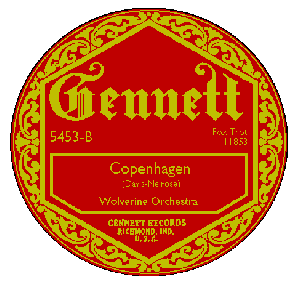
Last week, as I was driving through Richmond, Indiana, on my way home for the holidays, I was reminded of Hoagy and his musical cohort Bix Beiderbecke. Hoagy and Bix – together and separately - created several historic recordings at the Gennett Records studio in Richmond. The list of popular music pioneers who recorded at Gennett in the 1920s is a long one (Louis Armstrong, Jelly Roll Morton, Tommy Dorsey, et al.), earning Richmond the well-deserved title of “The Cradle of Recorded Jazz.”

Probably none of these names is as fabled as that of Beiderbecke – or, simply, Bix. The Iowa-born cornetist was known for a purity of tone and an innovative approach to soloing that helped mark the transition from Dixieland to modern jazz. His early death at age 28 also contributed to his legend as the embodiment of the convention-flouting, self-destructive musical prodigy.

As I reviewed some reference material on Bix, I ran across the following assessment from musician-critic Benny Green:


When a musician hears Bix's solo on 'Singing the Blues', he … knows … that this player is endowed with the rarest jazz gift of all, a sense of form which lends to an improvised performance a coherence which no amount of teaching can produce.
I think this is another example of the experience of mastery, in which a person, playing (literally) from an innate talent, is able to transcend the rudiments of a craft and attain the ineffable excellence of an art. The steps of the craft can be taught, but the sense of the art cannot.

What is the gift with which you are endowed? What sense of form – such as the arrangement of objects in space, or the arrangement of words in an interpersonal interaction - do you possess? What results do you create that seem to emerge as a coherent whole, in a manner similar to Hoagy Carmichael’s experience of composing “Stardust”?

What is your improvisational art?


Tuesday, December 22, 2009

After the Flood: Initiating Assertive Behavior


In my previous article, I described the distinction between assertive behavior and aggressive behavior. The essential difference: Assertive behavior seeks to make one’s ideas and opinions known while respecting the ideas and opinions of others, whereas aggressive behavior focuses primarily on “winning,” regardless of the impact on anyone else.

It’s easy to stereotype aggressive behavior as the exclusive domain of bullies, badgerers, and other bad actors. In fact, though, even the most well-meaning people can edge into aggressive territory whenever a dispute threatens to push their emotions out of control. This reaction to the overwhelm of emotion – which the relationship expert John Gottman refers to as “flooding” – often leaves the person with a Hobson’s choice: Either give in to the urge to lash out (and risk poisoning the air even more) or shut down completely (and risk sweeping the entire matter under the carpet, only to have it reemerge with a vengeance later).

In either of these situations, assertiveness as a response goes by the wayside. Assertive behavior requires a certain clear-headedness, an ability to lay out one’s case in an articulate, rational way despite the emotional charge of the situation – or, as Maggie Kuhn put it, the ability to “speak your mind, even if your voice shakes.”

So if you know that you’re susceptible to flooding, how can you prepare to react more constructively – more assertively – the next time you confront conflict? And is it even possible to “prepare to react”? Isn’t that as much a paradox as “rehearsing improv”?

Well, as with the (seeming) improv paradox, you can “prepare” to deal with a conflict situation not by drafting a specific set of scripted responses but by conditioning your intuitive mind to deal effectively in-the-moment with whatever the situation brings.

One way to do this is to quit thinking of assertiveness only as a reactive behavior that is only applicable to an emotionally charged conflict situation. Framing the issue in this way serves to reinforce your mind’s tendency to associate assertiveness with the flooding response and its accompanying no-win options.

Instead, as a way to reframe your thinking, consider finding opportunities to practice applying the “friendly” side of assertiveness. As described in the website Trans4Mind:
Assertiveness doesn't always wear a serious face; we are also being assertive when we smile, initiate a handshake, start or close a conversation, develop a friendship or relationship, express enthusiasm and happiness, and say "yes."
And, to use another improv concept, you can start thinking of assertiveness as an offer you can initiate in order to start a chain of positive behaviors.